Sewage Treatment
Compact. Quiet. Compliant. Built for built environments.
The Challenge
Why does your building consent require an on-site STP — and what are the consequences of non-compliance?
Hotels, IT parks, residential complexes, and mixed-use developments require on-site STPs under Maharashtra's (and most states') building bye-laws. The challenge: most STPs are noisy, odorous, and space-hungry — the opposite of what a premium development can afford. Navbharat Water's MBR-based STPs are designed to be invisible: below-ground, odour-free, and yielding treated water clean enough to reuse in flushing and landscaping.
of treated STP water can be reused for flushing and irrigation, reducing freshwater bills
How It Works
MBR technology — biological treatment meets membrane filtration.
Membrane Bioreactor (MBR) STPs combine conventional activated sludge with ultrafiltration membranes in a single compact tank, eliminating the large secondary clarifier of traditional systems.
Screening & Equalisation
Fine screens and a flow-equalisation tank buffer peak morning and evening loads. An enclosed, ventilated odour-control unit manages headspace gases at the inlet — critical for hotel basements and urban settings.
Membrane Bioreactor (MBR)
Submerged hollow-fibre UF membranes filter at 0.04 micron, producing permeate with BOD <5 mg/L and TSS <2 mg/L — far exceeding CPCB norms. The compact tank footprint is 30–40% smaller than equivalent SBR or MBBR plants.
Tertiary & Reuse
A chlorination contact tank provides disinfection to BIS-potable standards, enabling reuse in toilet flushing, cooling tower makeup, vehicle wash, and landscape irrigation. Dual-plumbing connection drawings provided for your MEP team.
One requirement, four proven technologies.
MBR is our flagship, but Navbharat Water engineers, builds, and maintains STPs across every major treatment technology — selected to match your site, budget, and reuse targets.
Membrane Bioreactor
Activated sludge combined with submerged 0.04-micron UF membranes. Best-in-class outlet quality (BOD <10 mg/L) in the smallest footprint — no secondary clarifier needed.
Best for: Premium developments, basements, high reuse targets (flushing, cooling tower makeup).
Moving Bed Biofilm Reactor
Free-floating plastic carrier media host the biofilm, boosting treatment capacity per m³ of tank. Resilient to load fluctuations and simple to operate with low sludge production.
Best for: Industrial campuses, dairies, and sites with variable hydraulic or organic loads.
Sequencing Batch Reactor
Fill-aerate-settle-decant cycles in a single tank. Proven, economical technology with good nutrient (N/P) removal and no separate clarifier — a workhorse for municipal-scale duty.
Best for: Townships, institutional campuses, and budget-conscious mid-to-large capacity plants.
Activated Sludge Process / Extended Aeration
The conventional aeration-plus-clarifier flowsheet, engineered with fine-bubble diffusers and energy-efficient blowers. Simple, robust, and easy to maintain with local operators.
Best for: Large plots where footprint is not constrained and operating simplicity is the priority.
Technical Specifications
Built for precision.
| Parameter | Value / Range |
|---|---|
| Capacity range | 10 KLD – 2 MLD |
| MBR membrane pore size | 0.04micron |
| Outlet BOD | ≤ 10mg/L |
| Outlet TSS | ≤ 10mg/L |
| Outlet faecal coliform | < 100MPN/100 mL |
| Footprint vs. SBR equivalent | 30–40% smaller |
| Odour control | Enclosed, ventilated, BioFilter |
| Noise level | < 55dBA at 3m |
MBR STPs achieve outlet BOD ≤10 mg/L and TSS ≤10 mg/L — far exceeding CPCB MINAS standards of BOD ≤30 and TSS ≤30. The 0.04-micron membrane pore size eliminates secondary clarifiers, reducing plant footprint by 30–40% versus equivalent SBR systems. Faecal coliform below 100 MPN/100 mL meets BIS flushing water quality for toilet reuse.
Case Study
Proven in the field.
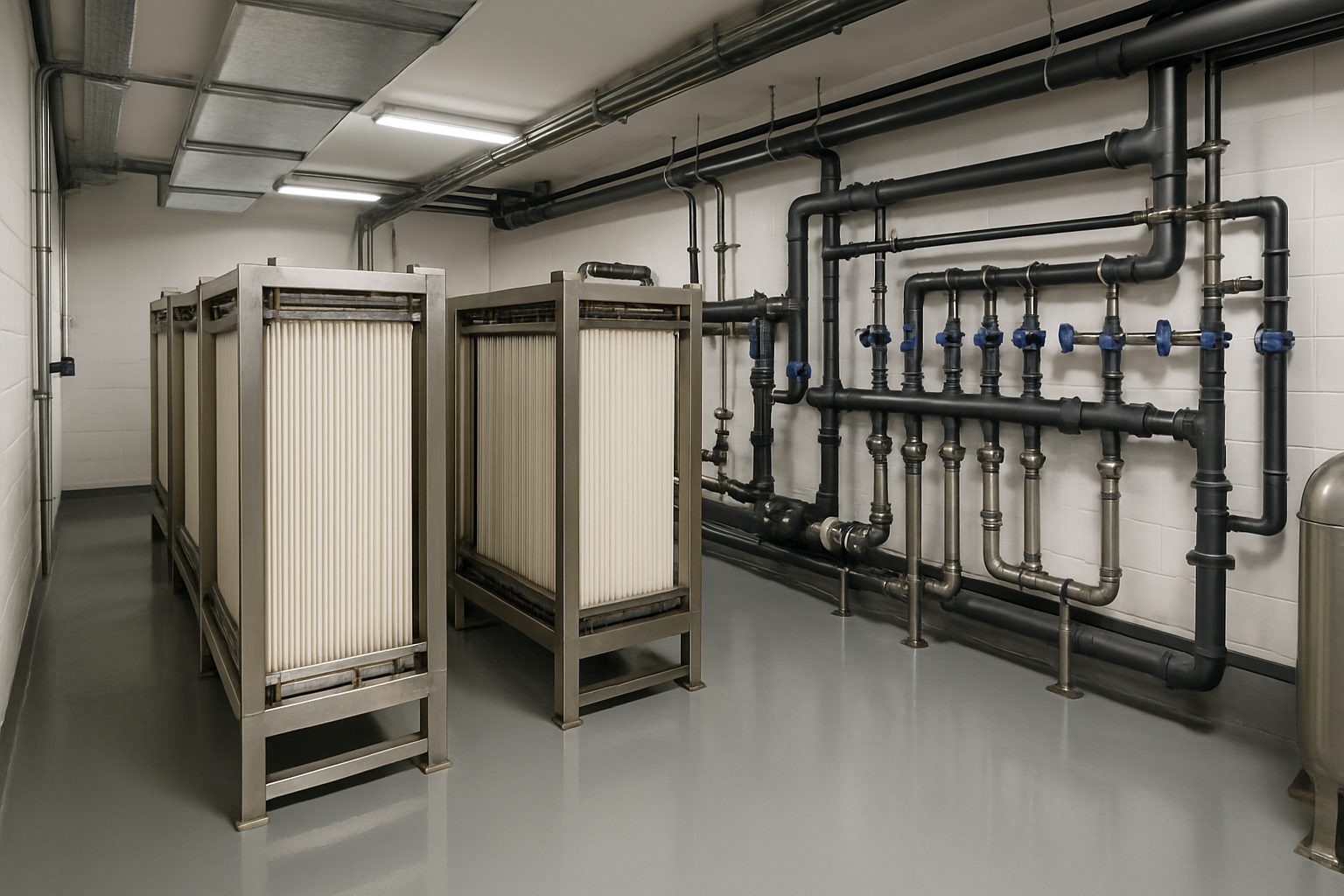
5-Star Hotel STP — 100 KLD, Mumbai, Maharashtra
MBR STP installed in basement plant room. Outlet BOD consistently <8 mg/L. 65 KLD recycled daily to toilet flushing and pool makeup — saving ₹22 lakh/year in MCGM water charges. Zero odour complaints from hotel operations team in 3 years of operation.
View all projectsCompliance Context
Which RERA, SPCB, and building bye-law standards must your STP satisfy for Occupancy Certificate?
STPs are mandatory for buildings above a certain area in most Indian states. Occupancy Certificates are withheld until the STP is commissioned and test reports submitted. Navbharat Water provides all documentation — commissioning reports, test certificates, and SPCB consent application support — to ensure your project timeline is not delayed at the final hurdle.
CPCB Minimal National Standards (MINAS) for STP outlet
State building bye-laws (MahaRERA, DTCP, BBMP, HMDA)
BIS IS 2490 — Tolerance limits for industrial effluents
ULB requirements for dual plumbing and reuse connections
GRIHA / LEED India certification credits (Water Efficiency)
What could you save?
Calculate your NPV, IRR & payback period
Frequently Asked
Common questions answered.
Related Industries
Designed for your sector.
Request a Technical Audit for Sewage Treatment.
Tell us your capacity, inlet profile, and compliance targets. We'll size a system that fits.